
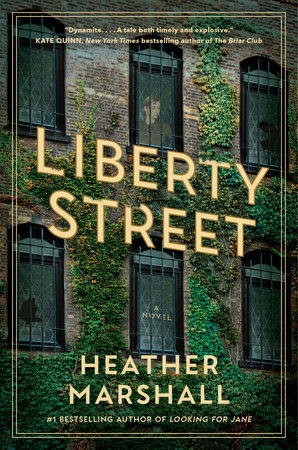
Recently I read Liberty Street by Heather Marshall. Our book club read her first book, Looking for Jane, on Hoarder Elizabeth’s recommendation. We all loved it and it meant I ran out and bought Liberty Street the moment it hit the shelves. At the close of the book though, I wrestled with my rating, and then realized I needed to be true to my own thoughts and my own reading experience of it, and not be influenced by my impression of her first book. If that makes sense to say. I liked it, but I didn’t love it, and had some complaints about it, which meant I determined it to be a 3.5 star read. Which is still great, but again, it wasn’t love for it.
I want to delve deeper into that rating to give more detail of how I got there, and for two reasons. One, is to maybe better explain ‘why’ to my fellow Hoarder Elizabeth (She’s shocked at the rating). Secondly, is because I received validation of my rating during our recent book club gathering. Another member of our club also read Liberty Street and gave a lengthy pause when asked if she liked it. She then said it was “implausible” in parts and I jumped up with a yes! That’s a great word to use. In my review on Goodreads I said it “stretched the truth”. This truth was stretched in the storytelling, not in its true-life events. And that is what I think I need to talk more about here.
Those true-life events that form the foundation of Marshall’s other books are very present here again as well. This time it is situated in a woman’s prison in Toronto in the 60s and it also blends into the story the Canadian magazine, Chatelaine. However, it was the way in which the story was told where it became too long, and like my friend Laura said, implausible. (Again, implausible for the way the story was told, not about the true events.)
Liberty Street is told using a dual-timeline. In 1961, Emily Radcliffe is working for Chatelaine magazine and is passed a note from a woman inside the Mercer Women’s Prison describing horrific conditions and treatment of the women imprisoned there. After doing some research, Emily discovers just how easily women can be sent to prison, and presses her editor to allow her to go undercover inside the prison so that she can report it in Chatelaine. In 1996, Detective Rachel Mackenzie is tasked with identifying human remains found in a small-town Ontario cemetery. Prior to being assigned to this case, Rachel is determined to continue to investigate a case of a missing girl that her (male) superiors have deemed closed. She is assigned this identification case as it seemingly keeps her away from creating trouble with those male superiors.
Again, the true-to-life details of the conditions inside the women’s prison, the treatment of those women, the experimentation, the testing of drug-trials, the sterilization of women, the ease of which women are imprisoned – yes – all very fascinating and infuriating to read about. Same goes for the details about Chatelaine and the many mentions of small towns and cities in Ontario. All great to read about. However, it was the fictional character and storytelling of and around Emily and the situations she finds herself in that took away some of the stars in my rating for this book. It was also the addition of the second timeline in 1996 that I felt was weakly connected. It is Emily’s timeline and story where the implausibility word shines through. Some of her situations and actions were where the stretching of my beliefs took place. I also found this to be too long overall, so that dreaded repetition I always struggle with, dragged this out and made me anxious for it to end. There were a few events in Emily’s timeline where my eyes rolled, and Rachel’s timeline seemed quite weak to me. Rachel’s story and timeline was patched together by tiny, sometimes irrelevant, and too thin threads to Emily’s and their connection and ending came in a rush.
Upon further reflection. This book would have been so much stronger had it done away with the dual timeline. Not every historical fiction book needs to fuss around with a dual timeline. I wish that Marshall stayed only with Emily and told her post-imprisonment life through her eyes throughout her years. This would have meant a deeper dive into the piece she was able to publish in Chatelaine and the public’s reaction, and finish the stories of the friends she made while at Mercer. Had this been the only story, I’m fairly certain my rating may have been higher. While these are my opinions, and may not be shared by all, these are the reasons why I gave Liberty Street a 3.5 star rating.
Have you read it? Do your thoughts differ from mine? I’d love to hear about it!


Leave A Reply